What if slowing down is the founder's real edge?
Maria Shum left big tech to build an AI stylist. For founders who feel pressure to move fast, her case for letting signal, revenue, and the raise wait.
The word that came back was “disappointing”
The first honest piece of feedback Maria Shum got on her product was a single word, and the word was disappointing. She had built an AI shopping tool, put it in front of early users, asked them what they thought, and what they handed back was not a bug report or a feature request but a verdict: “there’s nothing special about it.” She remembers the feeling exactly.
“Where the hell do you go from there?” she says.
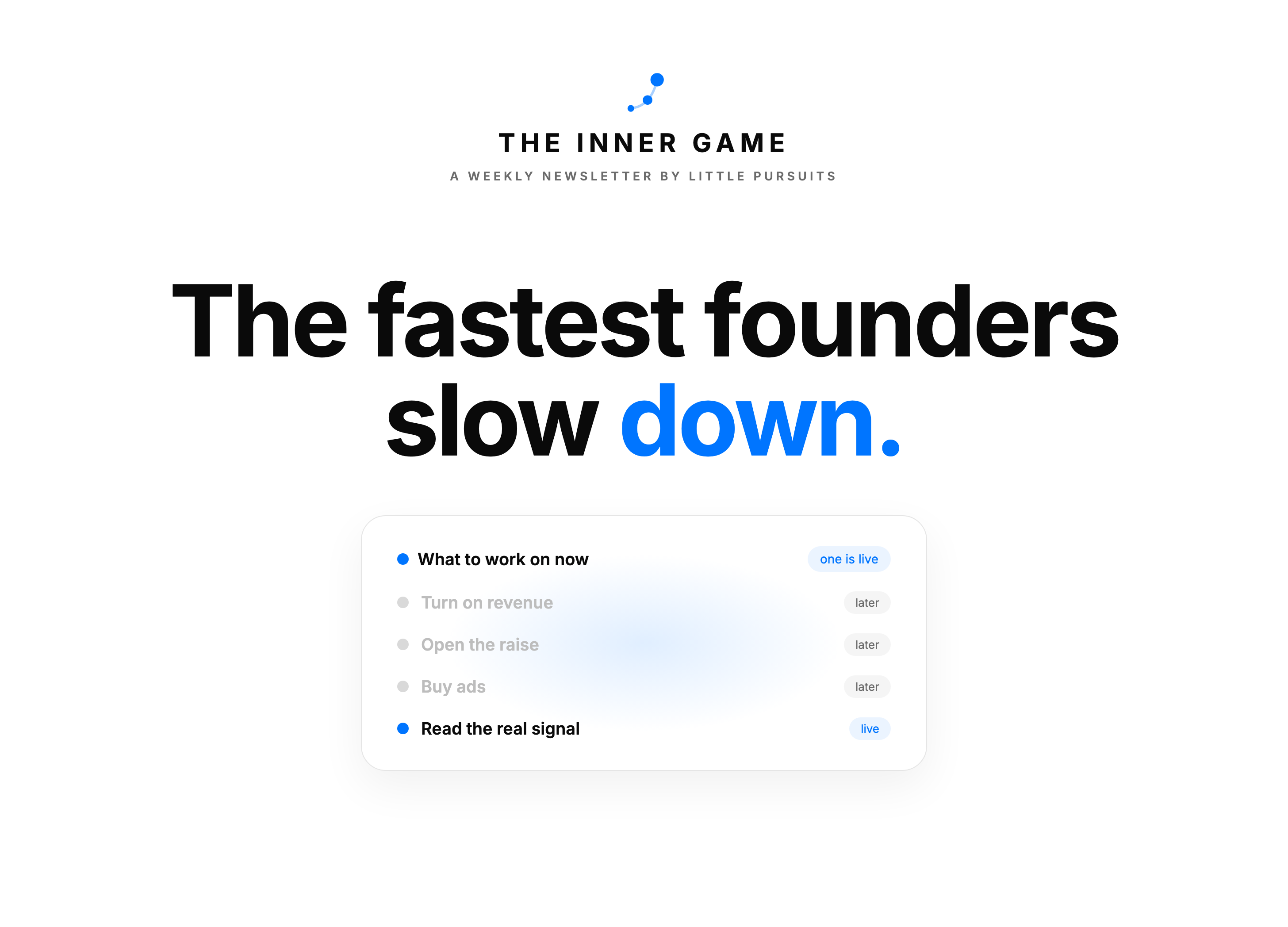
There is a version of that moment, the one startup culture quietly trains us to perform, where the answer is to go faster. Ship more. Add features. Turn on revenue. Open a fundraise, because momentum solves everything and standing still is the only real failure. The belief running underneath all of it is that speed is the founder’s edge, that the person who moves fastest wins, and that any pause is ground you are giving away. Maria did something else. She slowed down. And slowing down, she will tell you now, was the smartest thing she did.
If The Inner Game lands for you, subscribe to get each week’s issue in your inbox.
Maria spent years in product at companies including Meta and Adobe before leaving to build Lila, an AI stylist that helps people find something to wear for the occasions that actually matter, currently in its early alpha. You can watch the full conversation here:
What follows is less about the app than about the discipline she found while building it.
What she did instead of pushing harder
When the feedback came back flat, Maria resisted the instinct to declare the whole thing broken and start over louder. She went looking for what the disappointment was actually telling her. The original product was, in her words, “a glorified search bar,” and what she learned was that almost nobody shops the way a search bar assumes they do. The turning point was small and human. A friend’s daughter was hunting for a prom dress, so Maria simply talked to her, asked what she was looking for, listened as the girl sent pictures and described colors and cuts and the feeling she wanted. That single conversation taught her more than any dashboard, and it became the blueprint for how Lila now talks to the people who use her.
Underneath that move is a way of reading early evidence that most founders get wrong. “You can’t have statsig when you only have one or two people,” Maria says, using the shorthand for statistical significance. “What you’re going to get is signals.” Significance arrives at scale, and chasing it before you have scale is a way of staring at noise and calling it data. Signals are quieter and they require judgment, and judgment is the thing she kept choosing over speed.
She made the same choice with money. Users told her they loved Lila’s recommendations, and a few told her they had to stop themselves from buying on the spot, which is exactly the signal a founder is supposed to sprint toward. Maria parked it. Turning on payments would have dragged in security, risk, and compliance, a whole weather system her young product was not ready to hold, and the signal, while real, was not yet strong enough to bet the company on.
“Revenue is always gonna be there,” she says. The option to charge does not expire. The same logic applied to the raise. Fundraising kept pulling her attention away from the deep, slow work of building, the two demands opposing each other until neither got done well. So she set it down. “Fundraising will always be there,” she told me. “I can decide when that is the right time to go for it.” The trick, she found, was learning to hold a tempting thought without obeying it: “I can have that thought, but I don’t have to act on it.”
From the coaching room: pilots before the pitch deck
One of the questions founders bring me most often is some version of Maria’s: when do I turn toward fundraising, knowing it will pull time away from the product itself? I was working with a founder caught exactly there. I asked her a simple thing. Do you feel confident in how far the product has come and the traction you have? Not yet, she said. She was just starting to land her first pilot clients, and the proof was still forming.
So she made a deliberate choice. She put the bulk of her energy into landing those pilots and spent only a small slice of her time on fundraising, and even that slice she redefined. Rather than pitching cold, she used it to build relationships, warming up investors over time so that when she is genuinely ready to raise, the conversations will already be alive. She slowed the raise down not because she was avoiding it, but because she understood what her product needed first. That is the same instinct Maria describes, made concrete in one founder’s calendar.
What reappraisal does to a setback
The most quietly radical thing Maria did was with that first word, disappointing. She refused to let it be a grade. She had learned the move years earlier, failing product interviews, where she stopped scoring herself pass or fail and started scoring in parts. “I won these things, and then this part, so now something to focus on,” she says. A flat launch became information she could work with rather than a sentence handed down.
That instinct has a name in the research literature: cognitive reappraisal, the practice of reinterpreting a hard event instead of being ruled by your first reaction to it. In 2024, Alexander Stover and colleagues published the largest synthesis of this work to date in Clinical Psychology Review, pooling 64 samples across 55 studies and 29,824 people, and found that the more readily a person reappraises, the more resilient they tend to be, a moderate-to-strong association of r = 0.47. It lines up with an earlier and still-cited experimental review by Thomas Webb and colleagues in Psychological Bulletin, which showed that deliberately reframing a situation lowers its emotional charge, a small-to-medium effect of about d = 0.36 across hundreds of comparisons.
Two caveats keep this honest. The 2024 work is correlational, so it shows association rather than proof that reappraisal builds resilience, and most of these studies ran with general adult and clinical populations, not founders mid-build, so we are borrowing the finding by analogy. Reappraisal is no cure-all either; some recent trials question how much it adds once other supports are in place. Still, the direction holds across independent reviews. People who treat a setback as something to work with tend to find their footing faster than people who treat it as a final verdict.
Five ways to slow down without stalling
Slowing down is not the same as drifting. Here is the version a founder can run this week.
1. Name the one signal that matters now.
Pick the single thing your earliest users genuinely respond to, and let the vanity metrics wait. Statistical significance is a problem you earn at scale.
2. Write the tempting idea down, then leave it there.
Revenue, the raise, the shiny feature: capture it on a list so your mind can release it. The option will still be there when you are ready.
3. Start with talking to one real person, not a dashboard.
Maria’s whole product turned on a single conversation about a prom dress. One honest user will teach you more than a week of guessing.
4. Take the break before you are forced to.
Stepping away gave Maria the perspective she could not find while gripping the problem. Rest is part of the judgment, not a reward for it.
5. Score the setback in parts.
Separate what worked from what did not, and aim your next two weeks at the one part that needs you. A flat result is rarely a flat failure.
If a founder in your life is stuck in the speed trap, send this their way.
The detour is the road
Maria has a story she keeps returning to, about Little Red Riding Hood, who takes detour after detour and still arrives at grandmother’s house every time. The destination was never in doubt. The detours were where she learned the woods. That is the reframe Maria offers founders who feel slow: the time you spend waiting for real signal, parking the raise, reading a setback as data, is not ground lost on the way to the goal. It is how you gather what you need to choose well when the moment comes. She credits her own coaching, too, with giving her the clarity to commit to one direction instead of being pulled in ten, and the confidence to be, as she puts it, her own cheerleader through the parts that grind.
One more nudge: subscribe to The Inner Game and the next issue finds you on its own.
The week you stand still on purpose is not the week you fall behind; it is usually the week you finally see where you are going.
If you have lived this, the speed trap or the choice to slow down, I would like to hear how it went.
Join the Founder Circle.
The Inner Game grows out of the rooms where founders work through exactly these questions: when to raise, what signal to trust, how to keep going without burning down. The Founder Circle is that room. If you want company and a coach’s eye while you build, come join us.
Dar Patel is an ICF-certified executive coach (PCC) who works with founders and executives, and the writer behind The Inner Game, the weekly newsletter of Little Pursuits. Each issue turns one honest conversation into one idea you can use.
References
Stover, A. D., Shulkin, J., Lac, A., & Rapp, T. (2024). A meta-analysis of cognitive reappraisal and personal resilience. Clinical Psychology Review, 110, 102428.
Webb, T. L., Miles, E., & Sheeran, P. (2012). Dealing with feeling: A meta-analysis of the effectiveness of strategies derived from the process model of emotion regulation. Psychological Bulletin, 138(4), 775-808.
Read next